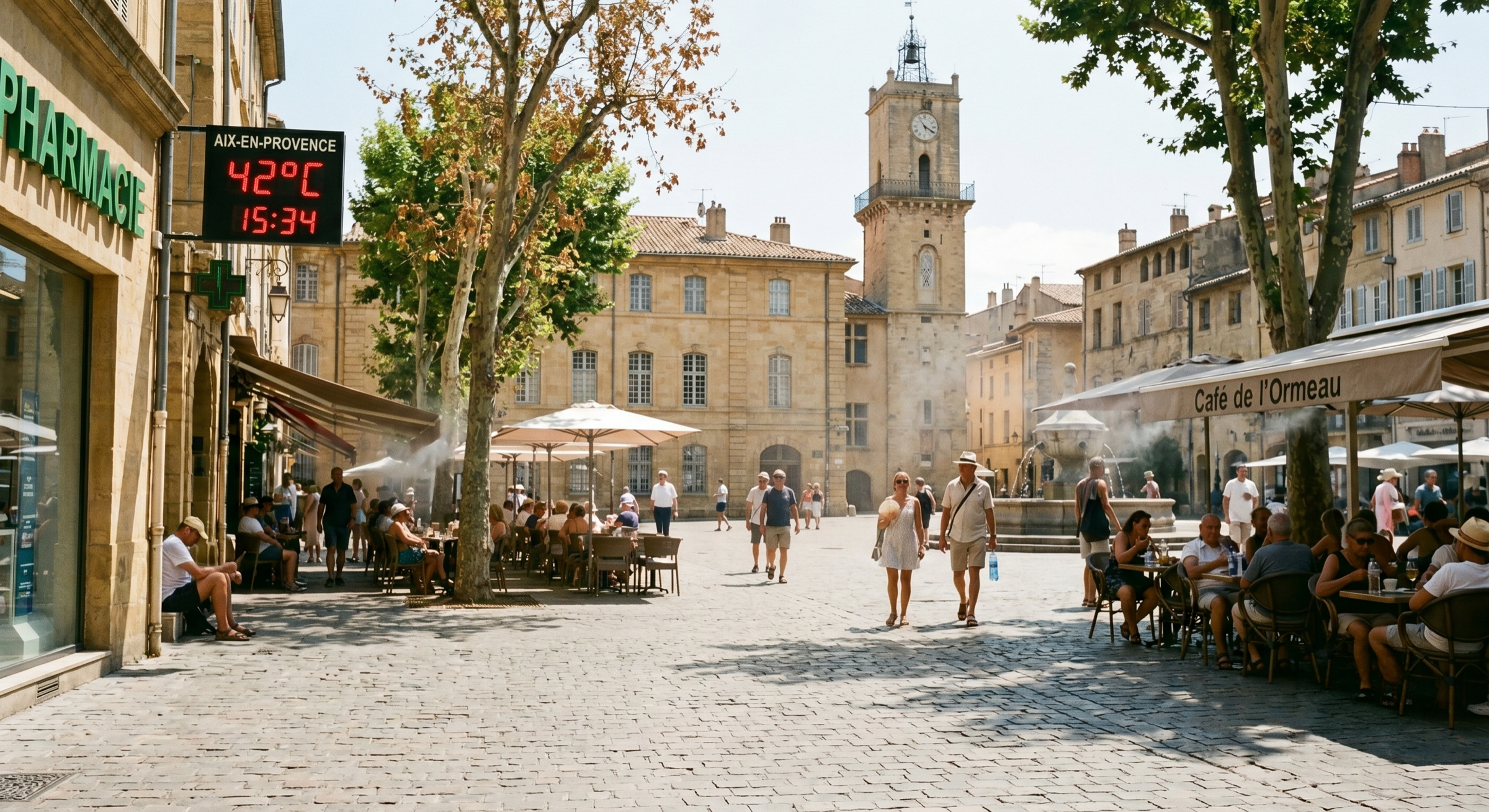
 We’re heading into our first full summer in France, and the question we keep getting from friends back in the States is some version of “wait, you don’t have air conditioning?” Mostly, no. And neither do most of our neighbors. Heat waves in France are a real thing. The French call them canicules, and the country takes them seriously. But the way people get through them looks almost nothing like an American summer.
No thermostat set to 68. No hum of a compressor outside the window. Just shutters, stone walls, good timing, and a pace of life that was slow to begin with.
After 18 years of LA summers, this took some adjusting. Here’s what we’ve learned so far, and why we’ve come around to it.
What a canicule actually is
A canicule is not just “it feels hot.” Météo-France defines it as an episode of very high temperatures, day and night, over a prolonged period, usually at least three days. The exact thresholds vary by department, because 35 degrees in one part of France does not mean the same thing as 35 degrees somewhere else.
France has a national alert system for this, with color-coded warnings by department, the same way we got flood alerts all winter. When one hits, it is on the news, pharmacies post reminders about hydration, and the whole country adjusts its schedule around it.
A French heat wave is usually a spike, not a season. It arrives, everyone hunkers down for three days to a week, and then it passes and the evenings are cool again. That is a different problem than summer in Phoenix, Texas, or the Valley in LA, where it can sit above 100°F for months and AC is not a comfort. It is life support.
Why almost nobody has AC here
Air conditioning never became standard in French homes the way it did in the United States. The most commonly cited estimate, reported by Le Monde, puts residential AC at roughly a quarter of French homes, based on an ADEME-linked survey from 2020. That number is imperfect and probably moving, but the bigger point still holds: most French households are not cooling their homes the way Americans do.
That sounds shocking to American ears until you remember two things.
First, France built much of its housing stock for a cooler world. Our farmhouse in the Dordogne has stone walls thick enough to lose a phone signal in. Those walls were stacked long before anyone was thinking about climate change, but they happen to be excellent insulation in both directions. The house holds the cool of the night well into the afternoon, the same way it holds the heat of the fireplace in January.
Second, for most of modern French history, you simply did not need it. Summers were warm, not punishing. A fan, a shuttered room, and a long lunch in the shade covered it. AC was for cars, movie theaters, and maybe the grocery store. The culture, the architecture, and the electrical grid all grew up around that assumption.
That assumption is getting tested now, and I will be honest about that further down. But the baseline matters: France is working from a climate that was, and still mostly is, cooler than most of the United States.
The house does the work, if you let it
Here is the actual playbook, learned partly from watching our neighbors and partly from getting it wrong:
- Open everything at night. Windows, shutters, doors between rooms. You are flushing the day’s heat out and banking the cool air.
- Close everything by mid-morning. By 10:00 AM at the latest, the shutters are shut and the house goes dark. It feels wrong at first, like you are hiding from the best part of the day. You are. That is the point.
- Stay low and stay in the shade. Ground floors stay coolest. Lunch moves to whatever side of the house the sun is not on.
- Do nothing from 2:00 PM to 5:00 PM. Not “less.” Nothing. The French treat the hottest hours the way Angelenos treat rush hour: you simply do not schedule your life inside them.
- Reopen after sunset and start the cycle again.
It is a routine, and once it clicks you stop thinking about it. The shutters on every French building exist for exactly this. They have been the climate control here for a couple hundred years.
The environmental case is hard to argue with
Americans do not think of AC as having a cost beyond the electric bill. But all that cooling takes electricity, and every compressor dumps its heat right back outside. That makes streets and courtyards hotter, which makes everyone run more AC. It is a loop.
The French approach mostly opts out of that loop. Thermal mass, shade, and timing cost nothing to run, and there is nothing to install, service, or replace. I am not going to pretend the environment is why we moved to France, but living in a house that cools itself with geometry instead of electricity does make the American default look a little wild in hindsight.
We kept entire glass office towers at sweater temperature in 95°F heat and called it normal.
It also matches how life works here
This is the part nobody warns you about: the no-AC system only works because the pace of life allows it. The afternoon shutdown is not a sacrifice in France because the afternoon was never when things got done here anyway.
Lunch is long. Stores close. Dinner happens after the heat breaks, at 8:30 PM on the patio, when the air is finally moving.
In LA, that schedule would have been professionally fatal. Here, it is just July. The whole country bends around the weather instead of bulldozing through it, and a canicule mostly asks everyone to do more of what they were already doing.
The honest part: France is getting hotter
I would be lying if I framed this as a perfect system. Heat waves in France are arriving more often and hitting harder than these houses were built for.
Météo-France says France has recorded 51 heat waves since 1947, with half before 2010 and half in the 15 years since. It also says those heat waves are becoming more frequent, earlier, later, longer, and more intense as the climate warms. The national heat-health alert system was created after the deadly summer of 2003, and it exists because this is no longer just a comfort issue.
New builds increasingly include cooling, portable AC units sell out during hot spells, and even our most “the old ways are best” neighbors will admit the old ways were designed for old temperatures.
So no, we are not anti-AC purists. We are going into this first summer with the shutter routine, a couple of good fans, and an open mind. If the gîte needs a mini-split for guests eventually, we will do it without apologizing.
The French approach is not “never cool your house.” It is “make the building and the schedule do 90 percent of the work first.”
That part translates anywhere, including back in the States.
FAQ
What does canicule mean in France?
A canicule is a prolonged period of very high daytime and nighttime temperatures, usually at least three days. Météo-France uses department-specific thresholds because heat risk depends on local climate and what people are used to.
Do most French homes have air conditioning?
No. Estimates vary, but the commonly cited figure is roughly one-quarter of French homes. That still means most households do not have fixed AC, especially compared with the United States.
How do French homes stay cool without AC?
The basic routine is to open the house at night, close shutters and windows by mid-morning, stay on lower floors, avoid the hottest hours, and reopen after sunset. Older stone houses are especially good at holding cool night air.
Is France getting too hot for the old way to work?
Sometimes, yes. The old routine still helps, but heat waves are becoming more frequent and more intense. More French homes will add cooling, especially for children, older people, guests, and anyone in poorly insulated housing.